
Adanced Water System
Village Water Supply System
Ecotrans
Product Features
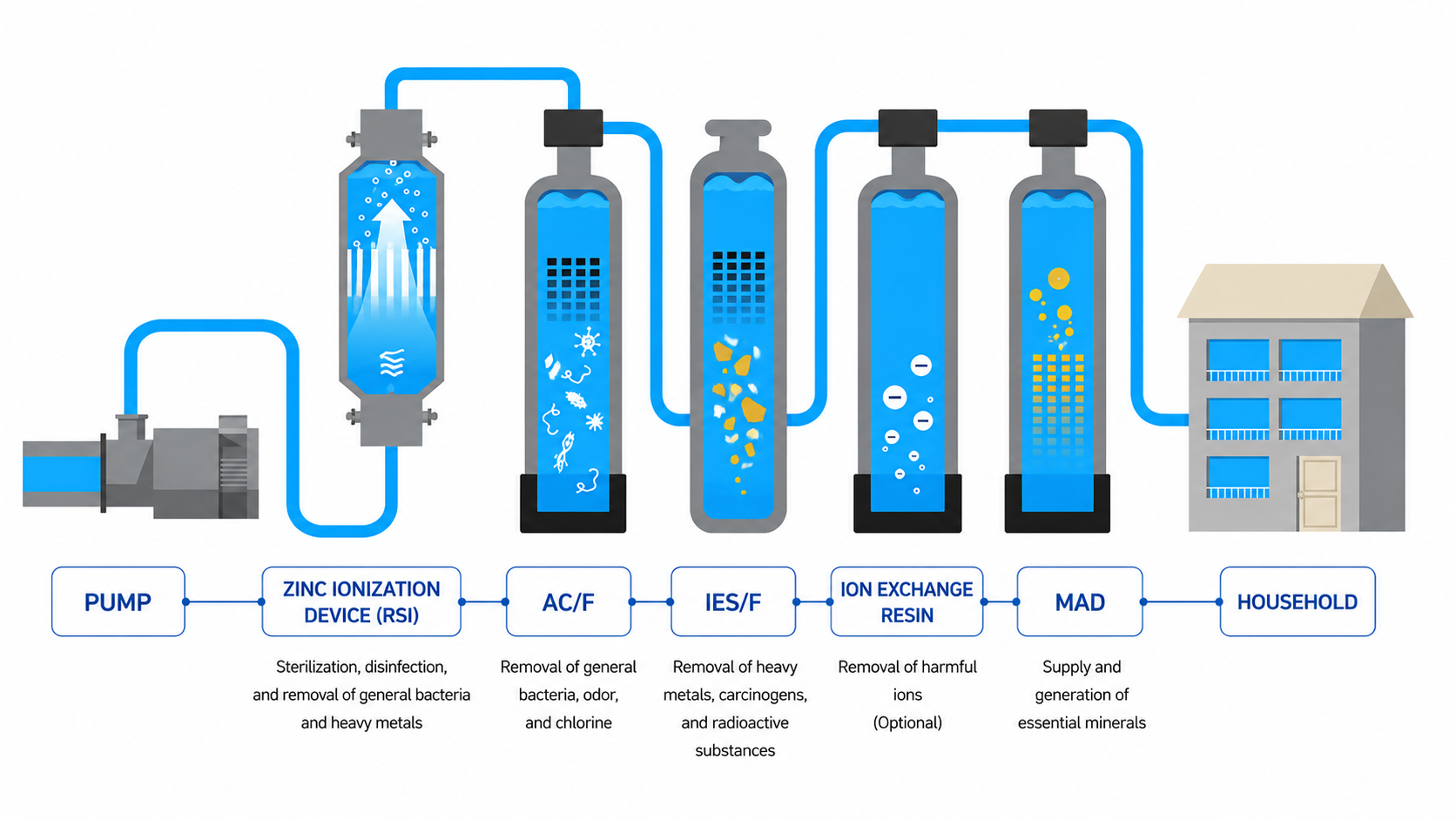
Key Functions of the Main Filters
|
Zinc Ionization Device (Jinhaeng RSI) |
Generates hydrogen peroxide through the ionization action of special zinc ions, temporarily sterilizing microorganisms and effectively disinfecting bacteria in water tanks and tap water. Zn²⁺ + 2H₂O + O₂ → Zn(OH)₂ + H₂O₂ |
|---|---|
|
AC Filter (Activated Carbon Filter) |
Removes general bacteria, odors, and chlorine compounds (disinfection byproducts) using activated carbon pores |
|
IES Filter (Ion Exchange Mineral Filter) |
Removes harmful heavy metals, carcinogenic substances, and radioactive materials using natural mineral pores |
| Ion Exchange Resin | Removes harmful ions through an ion exchange process (optional specification) |
|
MAD (Mineral Activation Device) |
Supplies and generates essential minerals using natural minerals |
Product Features
-
Low-Cost System
-
Easy On-Site Installation
-
Affordable Price
-
Easy Filter Replacement
-
Compact Design
-
Lightweight Product
Product Specifications
Water Pressure & Flow Rate
- System Pressure Drop
-
- Stage 1: 0.05–0.2 bar (estimated)
- Stage 2: 0.1–0.3 bar
- Activated Carbon Stage: 0.1–0.2 bar
- Total Initial ΔP: Approximately 0.3–0.7 bar
- Recommended Inlet Water Pressure
-
- Minimum Recommended: 2.0 bar or higher
- Standard Operating Pressure: 3.0–4.0 bar
- Maximum Design Pressure: 6.0 bar (Within tank and piping design specifications)
- Replacement Guidelines
-
- Replacement is recommended when the pressure drop (ΔP) of each stage reaches approximately 0.7–1.0 bar, or when the total pressure drop exceeds approximately 1.5–2.0 bar, as reduced performance and insufficient flow rate may occur.
Water Purification Filter Comparison
Ecotrans is an eco-friendly product that preserves minerals using natural purification methods and natural mineral materials, enabling easy water management.
| Category | ECO TRANS Filter | Reverse Osmosis (RO) | Activated Carbon Filter | Nano Filter |
|---|---|---|---|---|
| Filtration Method | Natural purification using natural mineral layers, activated carbon, and ion exchange resin | Water passes through a high-pressure membrane | Water passes through activated carbon pores | Nano-sized pore filtration |
| Pore Size | Physical filtration + mineral generation | Approx. 0.0001 μm | Approx. 0.01–0.04 μm | Approx. 1–10 nm |
| pH Level | 7.2–7.6 (Alkaline) | 5.5–6.9 (Acidic) | 7.0–7.6 (Alkaline) | 6.0–7.0 (Weakly acidic) |
| Contaminants Removed | Chlorine, general bacteria, harmful bacteria, heavy metals, green algae, scale, etc. | Removes 99% of heavy metals, bacteria, viruses, and organic matter | Bacteria, microorganisms, organic matter | Bacteria, viruses, heavy metals |
| Mineral Preservation | Preserved and enhanced | Removed | Preserved | Preserved |
| Filtration Speed | Fast | Slow | Fast | Fast |
| Wastewater Generation | None | Present | None | None |
| Filter Lifespan | Long-term use and washable | Relatively short | Medium | Short |
| Advantages | Eco-friendly, mineral supply, self-management possible | Ultra-high filtration, removes almost all contaminants | Fast filtration, mineral preservation, low cost | Removes fine contaminants, preserves minerals |
| Disadvantages | Not suitable for ultra-pure water, lower purification performance than RO | Mineral removal, wastewater generation, high electricity and filter replacement costs | Limited removal of heavy metals and carcinogens | Lower purification performance than RO, high filter cost |
| Recommended Applications | Rural water supply systems, natural eco-friendly water purification systems | Areas with high concern over heavy metals and viruses | General household drinking water safety | Environments with concern over fine contaminants |
Filter Replacement System
-
Tray-Type System
-
Hygienic
-
Convenient
- The tray-type system uses a structure in which filter media are inserted into a "filter module (tray)" format.
- Since the vessel or housing does not need to be fully disassembled, only the tray is easily replaced from the front, reducing maintenance time and simplifying upkeep.
-
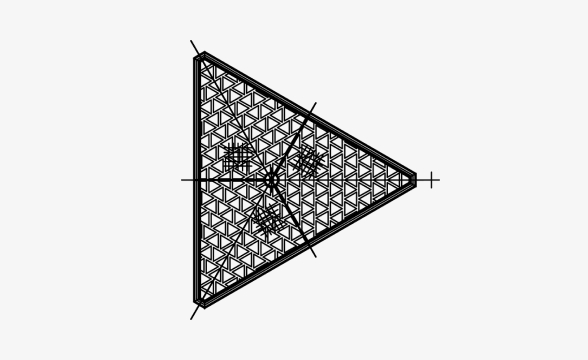
Tray Drawing
-
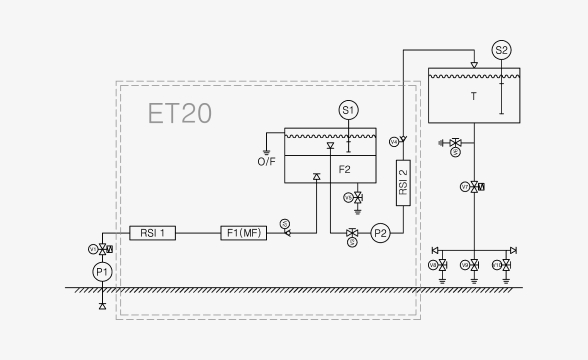
System Drawing
Product Development Evolution Process
-
nd Gen
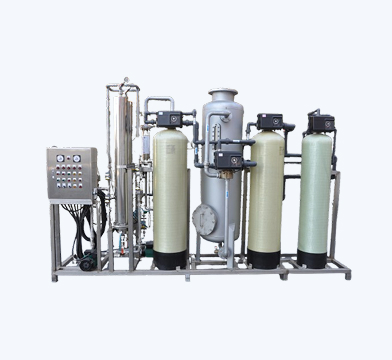
-
nd Gen
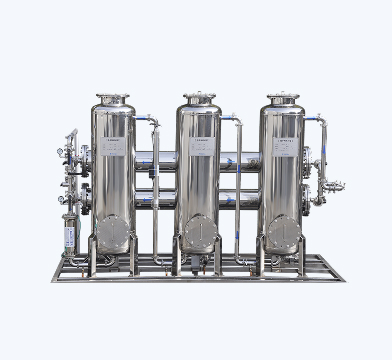
-
nd Gen
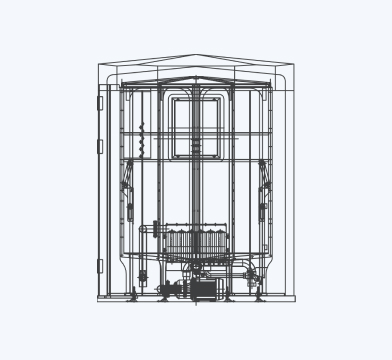
Development in Progress for 3rd Generation New System
Installation Benefits
- Installing new water supply pipelines costs approximately KRW 150 million per km (Approx. KRW 3 billion for a 20 km connection)
- Installing ECO TRANS requires only about one-tenth of the cost of new water pipeline construction, resulting in significant cost savings

Restores Confidence
Reduces concerns about water quality through the supply of natural minerals and water purification

Health Improvement
Promotes health by supplying essential natural minerals and zinc needed by the human body

Convenient Maintenance
Extends pipeline lifespan and improves maintenance convenience

Customized System Configuration
Flexible system configuration based on water quality and installation environment

Clean Water
Provides clean and safe water by removing bacteria, heavy metals, residual chlorine, and other contaminants

Budget Reduction
Significant budget-saving benefits compared to large-scale water supply infrastructure investment