Adanced Water System

Jinhaeng Waterway Lineup

Algal bloom Removal System

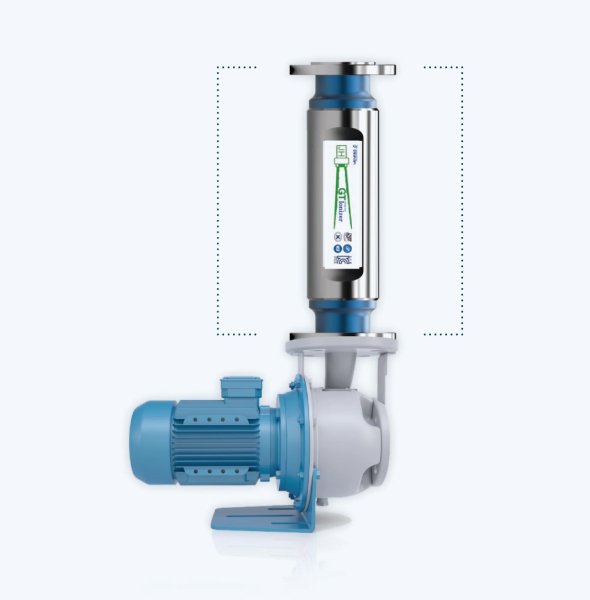
GT Ionizer

Product Introduction

What is GT IONIZER?

GT IONIZER for Eliminating Severe Summer Green Tide

An eco-friendly algae removal system that generates hydrogen peroxide through the zinc ion oxidation-reduction (REDOX) process to eliminate algae blooms.

Solve green tide problems with GT IONIZER, designed with people and the environment in mind.
No chemicals required — safe for humans and helps preserve the natural ecosystem.

Clean Water

Removes algae blooms and harmful substances

Eco-Friendly

No chemicals used
Preserves the natural ecosystem

Healthy Water

Harmless to the human body
No hazardous byproducts

Simple Installation

Easy installation
No external power required

GT IONIZER Algae Removal Mechanism

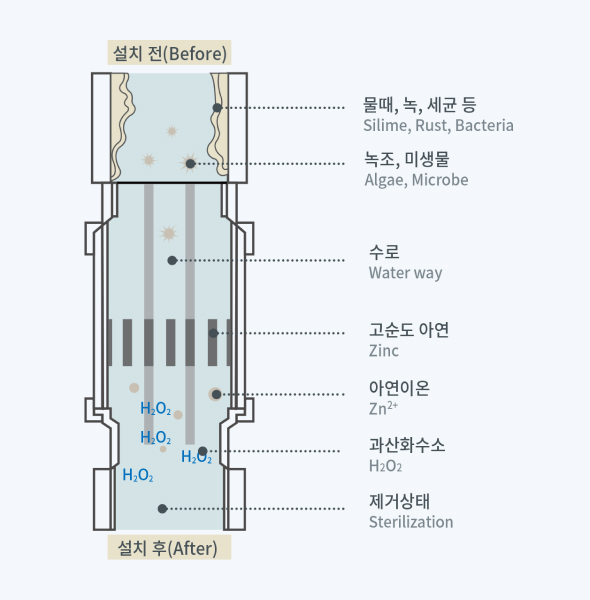
Algae Removal Mechanism
  1. STEP

    As high-purity zinc (Zn) slowly releases zinc ions (Zn²⁺) into the water, dissolved oxygen (or oxygen) in the water is converted into hydrogen peroxide (H₂O₂) (Grunberg, 1952). The generated hydrogen peroxide inhibits the growth of algae and other microorganisms.

    • Zn + H₂O + ½O₂ → Zn²⁺ + H₂O₂ + 2e⁻ → Zn²⁺ + 2OH⁻
    • 2H₂O₂ + C, H, O (microorganisms) → CO₂ + H₂O
  2. STEP

    As zinc ions are oxidized in water, hydrogen peroxide is eventually converted into hydroxide ions (OH⁻), increasing the pH level and forming zinc hydroxide precipitates (Zn(OH)₂). These substances adsorb phosphorus compounds (PO₄³⁻), a key nutrient for algae, thereby suppressing algae growth.

    • Zn²⁺ + 2OH⁻ → Zn(OH)₂ ↓
    • 3Zn(OH)₂ + 2H₃PO₄ → Zn₃(PO₄)₂ ↓ + 6H₂O
  3. STEP

    In addition, the generated zinc ions react with hydrogen sulfide (H₂S), a major cause of foul odors, and ammonia (NH₃), causing precipitation as zinc sulfide (ZnS) or forming zinc-ammonia complexes [Zn(NH₃)₄]²⁺, thereby reducing unpleasant odors.

    • Zn²⁺ + H₂S → ZnS ↓ + 2H⁺
    • Zn²⁺ + 4NH₃ → [Zn(NH₃)₄]²⁺

* Reference: Using hydrogen peroxide to control cyanobacterial blooms: A mesocosm study focused on the effects of algal density in Lake Chaohu, China, Environmental Pollution, published online on October 24, 2020, 115923

Zn + 2H₂O + O₂ Zn(OH)₂ + H₂O₂

Optimization of Algae Removal System Technology Using Zinc Ion REDOX
  1. Application of advanced oxidation water treatment processes through oxidant generation by oxidation-reduction reactions and additional UV lamp installation

  2. Generation of oxidants (hydrogen peroxide) through galvanic oxidation-reduction reactions

    O₂ + 2H⁺ + 2e⁻ → H₂O₂

  3. Zinc Ion REDOX Device (GT IONIZER)

  4. Generation of hydroxyl radicals through UV lamp installation (UV/H₂O₂ Process)

    H₂O₂ + hν → OH

    • Secures sufficient oxidation capacity through decomposition of algae, odor substances, and refractory organic matter
    • No additional chemicals required
    • Selective UV lamp installation depending on water quality characteristics for easy maintenance
  5. Enhanced algae removal efficiency through formation of magnetite (Fe₃O₄, magnetic material)

    Fe²⁺ + 2Fe³⁺ + 8OH⁻ → Fe₃O₄ + 4H₂O

    Electron reactions occurring during the bimetallic ionization process form magnetite (Fe₃O₄).

    • Advanced technology for removing algae and suspended matter using magnetic materials (magnetite)
    • Korea Institute of Geoscience and Mineral Resources (2010), Ministry of Environment Assignment